
2026 Optical Fiber Market Price Analysis
Core Conclusion
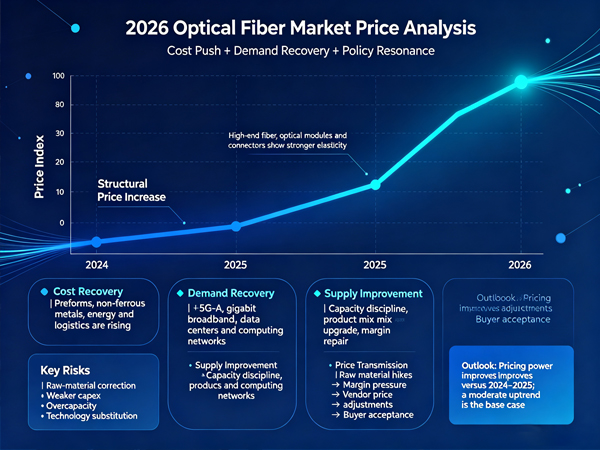
The pricing logic in the optical fiber market in 2026 is shifting from supply-demand mismatch to a combination of cost push, demand recovery, and industry policy support. Unlike previous price increases driven mainly by seasonal demand, this round is more likely to be a structural increase.
Common optical fiber prices may rise only moderately, while high-speed, large-bandwidth, low-loss, and specialty fibers—along with supporting optical modules, connectors, and cabling products—could see stronger pricing power.
Price Trends by Segment
| Product Category | Trend | Main Drivers |
|---|---|---|
| Standard communication fiber | Stable to slightly higher | Rising costs of preforms, metals, energy, and logistics |
| High-speed / broadband fiber | Noticeably higher | 5G-A, gigabit broadband, and data center buildout |
| Low-loss fiber | Firm pricing | Long-haul transmission and backbone network upgrades |
| Specialty fiber | Larger increase | Industrial, medical, defense, and sensing applications |
| Optical modules / connectors / cabling | Higher | Equipment upgrades, interface migration, and restocking |
Reasons for Rising Prices
1. Raw Material Cost Pressure
Cost pressure originates mainly from the upstream supply chain:
- Optical fiber preforms: Supply and price changes directly impact fiber manufacturing costs.
- Non-ferrous metals: Copper and aluminum increases push up cable, connector, and equipment costs.
- Energy and logistics: Higher electricity, natural gas, and transportation costs affect factory-gate prices.
- Chemicals and coating materials: Changes in fiber coatings and jacketing compounds affect mid- to low-end product pricing.
When upstream costs rise sustainably, manufacturers are more likely to pass them downstream.
2. Downstream Demand Recovery
Demand-side improvement is another important driver in 2026:
- 5G-A deployment: Higher bandwidth and lower latency increase demand for fiber and optical modules in fronthaul, mid-haul, and backhaul networks.
- Gigabit broadband expansion: Upgraded home broadband increases access-network fiber, ONT, router, and cabling demand.
- Data centers and computing networks: AI computing, cloud services, and data center clusters drive demand for high-speed optical modules and high-density cabling.
- Industrial and sensing applications: Industrial control, rail transit, energy monitoring, and medical equipment increase specialty fiber demand.
- Operator capex recovery: If operators increase investment in computing networks, transport networks, and access networks, the fiber-optic cable sector could improve significantly.
3. Supply-Side Adjustments
Supply-side changes are also supporting prices:
- Some manufacturers reduced capacity during the industry downturn;
- Capacity expansion for high-end and specialty fiber remains slow;
- Companies are shifting from price competition to margin protection;
- Leading players are improving product mix by increasing high-margin products.
As a result, profitability could improve faster than average selling prices in 2026.
Transmission Mechanism
Price increases in the optical fiber market usually spread gradually through the value chain rather than rising all at once.
Step 1: Upstream materials rise
Preforms, metals, chemicals, and electronic components increase in price.
Step 2: Manufacturers face margin pressure
Fiber, cable, module, and connector suppliers see compressed margins; weaker players may become unprofitable.
Step 3: Vendors test higher prices
Industry leaders or key suppliers adjust their new-list prices, and others may follow.
Step 4: Downstream customers respond
Operators, system integrators, and equipment vendors decide whether to accept higher prices based on project timing, inventory, and competition.
Step 5: Pricing diverges
Standard products see limited increases, while scarce, high-end, and customized products rise more.
Outlook for 2026
View 1: Better pricing power than 2024–2025
After the industry downturn, optical fiber prices have a stronger foundation for recovery in 2026. However, the increase is likely to be moderate rather than explosive.
View 2: Structural increase is the main theme
Key areas to watch include:
- high-speed fiber;
- low-loss fiber;
- specialty fiber;
- high-speed optical modules;
- connectors and cabling products;
- data center infrastructure.
View 3: Profitability may improve faster than ASP
If companies improve product mix, control capacity, and reduce operating expenses, margin recovery could outpace average selling price growth.
Risk Factors
表格
| Risk | Potential Impact |
|---|---|
| Raw material correction | Weakens the cost-push story |
| Weaker-than-expected capex | Limits demand recovery |
| Overseas market volatility | Harms export-oriented vendors |
| Overcapacity | Restarts price competition |
| Technology substitution | Reduces demand for traditional fiber |
Implications
For Manufacturers
- Focus on high-margin product mix;
- Control low-end capacity expansion;
- Secure long-term agreements with key material suppliers;
- Strengthen specialty fiber and customization capabilities;
- Build inventory and price-risk management mechanisms.
For Distributors and Integrators
- Monitor price inflection points and manage inventory carefully;
- Lock in long-term supply agreements where possible;
- Maintain supplier diversity for high-end and scarce products;
- Re-evaluate project pricing when costs change.
For Downstream Buyers
- Develop cost forecasts for long-cycle projects;
- Maintain safety stock for critical materials;
- Include price-adjustment clauses in bids and contracts;
- Consider domestic substitution and multi-sourcing strategies.
Image caption: The English chart shows a gradual upward “Price Index” from 2024 to 2026, with supporting modules for cost recovery, demand recovery, supply improvement, and price transmission.